
The deadliest months for New Forest livestock are November and December as days become shorter and the clocks go back.
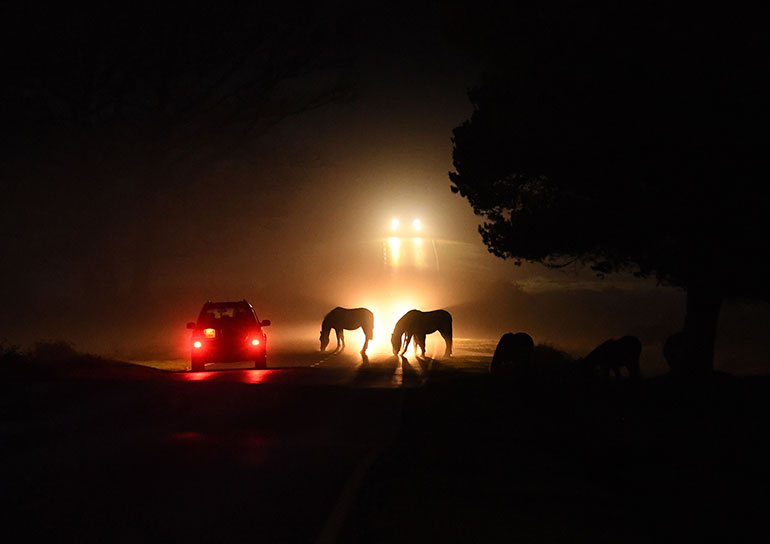
With darker nights and the clocks changing this weekend drivers are warned to be prepared to stop for New Forest animals. If you collide with a pony, cow, donkey, pig or sheep you are required by law to report it to the police by ringing 999.
Forest organisations are appealing to road users to expect the unexpected and remember that animals have right of way on unfenced New Forest roads.
In 2019, 58 animals were killed and a further 32 were injured whereas in 2020, when traffic was reduced by Covid-19 restrictions, 50 animals were killed and a further 21 were injured.
While speed is a major contributing factor to animal accidents driving to the road and weather conditions can be just as important. Low light in winter, dazzling oncoming headlights and bad weather can make visibility extremely poor.
Last year’s accident figures were the lowest on record, but this year the roads are due to be busier as more people are driving to and from work.
“Forest organisations work all year round to reduce animal accidents with initiatives such as prominent road warnings and deploying the mobile police speed camera van,” said the New Forest National Park Authority’s executive director, Steve Avery. “Evidence shows that most animal accidents are caused by commuters who travel along the same roads daily. Accidents can happen at any speed and cause untold suffering to the unfortunate animal, can result in injuries to people in the car and may result in a badly damaged vehicle. By slowing down in the dark, especially when oncoming vehicles approach, drivers, their passengers and the animals will be much safer.”
Here are some tips for drivers:
- Be ready to stop – animals can step out even when they’ve seen you approaching.
- Drive slowly, especially in the dark – there is a pool of darkness behind the headlights of approaching cars and an animal may be standing in it.
- Give animals grazing by the side of the road a wide berth – cross to the other side of the road and be prepared to STOP if there is oncoming traffic.
- Grazing animals on both sides of the road? Take extra care – they may cross to join their friends.
- One animal by the roadside means there are others close by – be aware.
- Bends and tops of hills need more care – animals may be standing in the road just out of sight.
- Reflective collars worn by some ponies may help you see them in the dark – but be aware that not all ponies have them.
- Deer can easily jump the fences alongside roads such as the A337, A31 and A35 – and when there is one deer more will usually follow.
- Be animal aware at all times.
Gilly Jones, commoner and spokesperson for Animal Accident Road Awareness said: “Everyone as soon as they cross a cattle grid has to drive with livestock as their main concern. Any animal can and will walk out, they do not know where you are going, and you have no idea where they are going too. No one would drive carelessly past a child in the road. You have to think that all animals are your small children and give them the same respect. Over the years I have spoken to many of those who have been unfortunate to hit an animal. Think how it will affect you and others in your vehicle maybe for years to come.”
Charlotte Lines, chair of the New Forest Commoners Defence Association, said: “Great work has been done by several forest groups working together to reduce the number of road traffic accidents involving commoners’ livestock. Reflective collars for ponies and ear tags for cattle are just two of the initiatives commoners are implementing to reduce the risk, however there are still too many casualties. Animals can just appear from nowhere and in an instant, so we ask users of forest roads to drive with care and caution over the winter months and help us protect our animals.”
Most of the drivers involved in animal accidents are relatively local people on regular trips. The high-risk routes have been identified as:
- the B3078/79 from Cadnam to Godshill
- the B3054 from Lymington to Dibden Purlieu
- the B3055 from Brockenhurst to Sway
- the C10 from Picket Post to Holmsley.
The New Forest’s Animal Accident Reduction Group has spearheaded a range of measures including police mobile speed cameras on the most dangerous routes and reflective warning signs on key roads during the winter months when accidents peak.
The group is supported by the New Forest Commoners Defence Association, Forestry England, Verderers of the New Forest, New Forest National Park Authority, New Forest District Council, Hampshire County Council, Hampshire Constabulary, New Forest Trust, New Forest Association and British Deer Society and Animal Accident Road Awareness.
If you do have an accident involving a pony, cow, donkey, pig or sheep you are required by law to report it to the police by ringing 999 as soon as possible. A reward of up to £5,000 is offered for information leading to the successful conviction of drivers prosecuted for failing to stop and report an accident involving a New Forest animal.
Head agister Jonathan Gerrelli, who is responsible for supervising the day-to-day welfare of the animals, said: “A ‘hit and run’ is the last thing we want, where an animal could be left in pain for hours or days if not reported. Even if it runs off, the animal could be seriously injured, so call the police and an agister will be sent out to search for the casualty.”
The number of commoners’ animals killed and injured has almost halved in the last 20 years. Sadly though, high numbers of accidents continue to happen.
Find out all the latest initiatives and animal accident data on the New Forest National Park Authority website: www.newforestnpa.gov.uk/animal-accidents